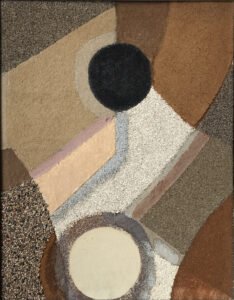
Alfred RETH (1884–1966) was a Hungarian-French painter and visual artist, regarded as one of the key figures of the École de Paris and the 20th-century avant-garde. His early works evolved from a Cubist-inspired approach into a highly experimental form of abstraction, characterized by geometric fragmentation, dynamic line work, and a refined sense of composition. His later works incorporated layered transparencies, intricate textures, and rhythmic patterns, seamlessly blending structured precision with expressive spontaneity.
Reth was among the earliest artists to explore abstraction, and by the 1920s, his paintings featured intricate arrangements of lines, planes, and curves. In 1931, he joined Abstraction-Création: Art Non Figuratif, a group that included artists such as Arp, Georges Valmier, Herbin, and Kupka, dedicated to promoting abstract art through exhibitions. After World War II, he continued exhibiting with the Salon des Réalités Nouvelles, founded in 1946 to support abstract art.
Reth’s artistic style evolved significantly throughout his career, transitioning from early representational works influenced by Impressionism to fully abstract compositions focused on form, color, and spatial relationships. Later in life, Reth remained dedicated to abstraction but also revisited figuration. He also returned to collage, a technique he had first experimented with in 1906. Using paper and collaged pieces of colorful printed fabrics, he incorporated new materials into his work, making texture a central element of his practice until 1960. In 1966, the year of his death, a retrospective of his work was held in Chicago, honoring his lifelong contributions to modern art.
Although Alfred Reth’s contributions to modern art were significant, his work did not receive widespread recognition during his lifetime, partly due to his quiet demeanor and the overshadowing presence of more prominent figures in the Parisian art world. In recent years, however, appreciation for his innovative approach and his ability to synthesize diverse influences into a cohesive visual language has grown. Today, Reth’s work is celebrated for its refinement, intellectual depth, and timeless appeal, securing his place among the pioneers of abstraction.