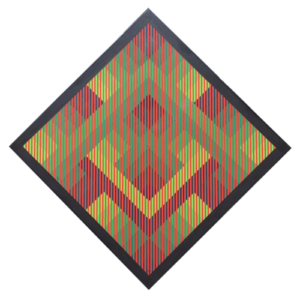
Mehdi MOUTASHAR (born 1943) is an Iraqi-born French visual artist renowned for his innovative exploration of geometric abstraction and the interplay between form, space, and perception. Drawing from both Islamic aesthetics—particularly the use of geometry and symmetry—Moutashar blends these traditional elements with the principles of modern abstraction, creating works that are both rooted in cultural heritage and markedly contemporary. His compositions often feature modular grids, intersecting planes, and bold contrasts, drawing inspiration from Arabic calligraphy, architectural motifs, and minimalist aesthetics.
Moutashar’s artistic journey began with formal training at the Higher Academy of Fine Arts in Baghdad before continuing his studies at the École Nationale Supérieure des Beaux-Arts in Paris. Settling in France in 1967, he pursued both artistic and academic careers, serving as a professor at the École Nationale Supérieure des Arts Décoratifs in Paris from 1974 to 2008. His background in both Western modernism and Middle Eastern artistic heritage informs his distinctive approach, which deconstructs traditional visual elements into highly refined abstract compositions. Since the 1970s, he has developed a unique visual language that merges historical influences with contemporary conceptual frameworks.
Throughout his career, Moutashar has exhibited extensively in Europe and the Middle East, with his work included in prominent collections such as the Bibliothèque Nationale and the Institut du Monde Arabe in Paris. Notable exhibitions include his participation in François Morellet et Mehdi Moutashar at the Institut des Cultures de l’Islam in Paris and Beyond Form: Richard Serra / Mehdi Moutasharat the Palais du Tau in Reims. His contributions to abstraction were also recognized in Homage to Malevich’s Black Square at the Vasarely Museum in Budapest, reflecting his engagement with the broader dialogue of geometric abstraction.
Moutashar’s work leaves a lasting impression on the field of contemporary abstraction, offering a refined synthesis of tradition and innovation. His ability to distill complex cultural and formal elements into minimal yet deeply expressive compositions positions him as a vital figure in global modernism. By continuing to explore the intersections of East and West, historical symbolism, and modernist reduction, his work resonates with both contemporary audiences and the ongoing evolution of abstract art.